Mitsubishi Lancer Evo 10 - Malaysia
Wednesday, February 3, 2010
WORLD COOLEST POLICE CARS
Mitsubishi Lancer Evo 10 - Malaysia
Labels:
FUTURISTIC,
GENERAL KNOWLEDGE
12METER SKELETON OF A MAN
<

The first message appeared on the Internet, reporting that the skeleton was detected somewhere in the deserts of western India. The Indian government has cordoned off the area of the Indian Army and did not allow anyone except a special National Geographic excavation team.


Labels:
WEIRD
World's Fastest Trains
They are fast. Super fast. They are futuristic, comfortable and safe. Super safe. The world's fastest trains, be it magnetic levitation or conventional line, can easily rival their air competitors. They might not be as fast as planes, but they are so much more reliable, punctual, safer and greener.
See which countries can boasts the fastest trains in the world.
The Ave system has absolutely nothing in common with the Spanish relaxed attitude toward time. On the route between Madrid and Seville, RENFE assures an arrival within five minutes of the advertised time, offering a refund if the train is delayed further. However, to date only 0.16% of trains have been delayed more than a few minutes. So not Spanish!
Another fast model among the Chinese high speed trains is CRH2, produced by the Japanese Kawasaki Heavy Industries. In October 2009 the Ministry of Railways announced that it planned to invest 1.2 trillion yuan ($175.44 billion) to develop and extend the railway system in China. The aim is to have 13,000 km of passenger lines by 2012. A new contract for 140 new 350km/h capable high speed trains has also been signed between the Ministry and Nanche Sifang Locomotive through a technology licensing agreement with Kawasaki Heavy Industries.
In 2003, during a trial run, a Maglev vehicle achieved a Chinese record speed of 501 km/h (311 mph).
The Transrapid trains have not yet been implemented on long-distance intercity lines.
Among the fastest TGV trains are TGV Réseau and TGV Duplex- their top speed is 320 km/h (199 mph). The trains hold the world's highest average speed for a regular passenger service.
In 2007 SNCF, the TGV operator, and Alstom, the TGV builder, carried out a series of high speed trials. The official speed record attempt took place on 3 April 2007, when TGV reached the top speed of 574.8 km/h (159.6 m/s, 357.2 mph). It is the fastest conventional train that uses powered metal wheels riding on metal rails.
In 2003, the three-car train JR-Maglev achieved 581 km/h (361 mph) on a magnetic-levitation track, wining the title of the fastest non-conventional train in the world. On average, bullet trains are capable of running at a speed of 300 km/h (186 mph), but Japan has already commenced works on constructing a new Shinkansen that could achieve a speed of 360 km/h (224 mph). The new train, named E5 series, will start operating in 2012 and will run between Tokyo and Shin-Aomori stations, 54 minutes faster than the previous model.
If only more countries could have such an ambitious rail system.
See which countries can boasts the fastest trains in the world.
5. AVE. Spain.
300 km/h (186 mph)
AVE, meaning Spanish High Speed (Alta Velocidad Española), or simply "bird", runs at speeds of up to 300 km/h (186 mph). The trains are operated by RENFE, the Spanish state railway company, but there is also the private operator Alvia, whose trains run at a maximum speed of 250 km/h (155 mph).The Ave system has absolutely nothing in common with the Spanish relaxed attitude toward time. On the route between Madrid and Seville, RENFE assures an arrival within five minutes of the advertised time, offering a refund if the train is delayed further. However, to date only 0.16% of trains have been delayed more than a few minutes. So not Spanish!
4. CRH. China.
350 km/h (217 mph), top speed 394.3 km/h (245 mph)
China Railway High-Speed, the Chinese rail system, operates a number of bullet train models such as CRH1, CRH2, CRH3, CRH4 and CHR5. The fastest type is CRH3, based on Siemens Velaro technology, designed to run at the speed of 350 km/h (though in 2008, a CRH3 reached a top speed of 394.3 km/h (245 mph) during a test carried out on the line between Beijing and Tianjin).Another fast model among the Chinese high speed trains is CRH2, produced by the Japanese Kawasaki Heavy Industries. In October 2009 the Ministry of Railways announced that it planned to invest 1.2 trillion yuan ($175.44 billion) to develop and extend the railway system in China. The aim is to have 13,000 km of passenger lines by 2012. A new contract for 140 new 350km/h capable high speed trains has also been signed between the Ministry and Nanche Sifang Locomotive through a technology licensing agreement with Kawasaki Heavy Industries.
3. Shanghai Maglev Train. China.
250 km/h (160 mph), top speed 431 km/h (268 mph)
The high speed monorail train called Transrapid is a German invention that uses magnetic levitation. Currently, the only commercial implementation of the system is in Shanghai, China. The train runs the distance of 30 km from the airport in 7 minutes 20 seconds, at the average speed of 250 km/h (160 mph) and the top speed of 431 km/h (268 mph).In 2003, during a trial run, a Maglev vehicle achieved a Chinese record speed of 501 km/h (311 mph).
The Transrapid trains have not yet been implemented on long-distance intercity lines.
2.TGV. France.
320 km/h (199 mph) top speed 574.8 km/h (357.2 mph).
TGV is a flagship product of France, almost as iconic as the Eiffel Tower and baguettes. The high-speed train service was developed during the 1970s and opened to the public in 1981. At present it reaches 150 destinations in France and several foreign cities located in Belgium, Germany, Luxembourg, Italy and Switzerland.Among the fastest TGV trains are TGV Réseau and TGV Duplex- their top speed is 320 km/h (199 mph). The trains hold the world's highest average speed for a regular passenger service.
In 2007 SNCF, the TGV operator, and Alstom, the TGV builder, carried out a series of high speed trials. The official speed record attempt took place on 3 April 2007, when TGV reached the top speed of 574.8 km/h (159.6 m/s, 357.2 mph). It is the fastest conventional train that uses powered metal wheels riding on metal rails.
1. Shinkansen. Japan.
300 km/h (186 mph), top speed 581 km/h (361 mph)
The Japanese knack for technology is manifested in the high speed railway system that covers the entire country. The Japanese Shinkansen, also called a bullet train, is super fast, super safe (40 years of operating without a single major accident) and super comfortable - it runs at least six times per hour between Tokyo and Osaka, and the average arrival time is within six seconds of the scheduled time.In 2003, the three-car train JR-Maglev achieved 581 km/h (361 mph) on a magnetic-levitation track, wining the title of the fastest non-conventional train in the world. On average, bullet trains are capable of running at a speed of 300 km/h (186 mph), but Japan has already commenced works on constructing a new Shinkansen that could achieve a speed of 360 km/h (224 mph). The new train, named E5 series, will start operating in 2012 and will run between Tokyo and Shin-Aomori stations, 54 minutes faster than the previous model.
If only more countries could have such an ambitious rail system.
Labels:
FUTURISTIC,
GENERAL KNOWLEDGE
World's Most Dangerous Cities
The crime statistics of world's five most dangerous cities are disheartening and shocking. With such high rates of homicide, robberies and violence these cities deservedly bear the names of 'the places of chaos and death' or 'the murder capitals of the world'. Despite the scary data, some of them still remain wanted tourist destinations, though extreme caution is strongly advised when visiting.
The "good" news is that the number of killings declined by 3.4% to around 18 000 (sic!) between April 2008 and March 2009. Still there are 50 murders a day in South Africa. The latest data shows that there have been 71,500 sexual offenses (10% increase), 18,400 burglaries (27% increase), and 13,900 business robberies (41% increase) reported from April 2008 to March 2009. If it's any consolation, the street robbery declined by 7% to 72,194.
The beautifully located Cape Town is among the most dangerous towns in the country due to its high level of robberies, rapes, kidnappings and murders. The city is about the same size as Caracas and it has a murder rate of 62 per 100,000 inhabitants. According to the police, the homicides usually occur in the poorer districts and suburbs of the town rather than in upscale areas. Due to the poverty (the country has been facing a deep recession) the robberies are common. Therefore, traveling alone and using ATM's at night is not advised.
Still, according to the FBI data there have been 95 homicides per 100,000 residents in 2008. In turn New Orleans Police Department reported 67 murders per 100,000 in 2008. A scary comparison has recently been made by the Time magazine stating that Baghdad in Iraq with its murder rate of about 48 per 100,000 people is now being safer, considering the statistics, than New Orleans.
Violent crime is a serious problem especially in the low-income neighborhoods of the town. Lonely Planet advises travelers to New Orleans to be cautious and avoid walks at night, especially if you are alone.
At the end of 2008 the Foreign Policy magazine called the city "the murder capital of the world". According to the official statistics there have been 130 homicides per 100,000 residents in 2008. Only in December 2008 there were at least 510 people killed in the capital, as CNN reported.
Moreover, experts underline that the murder ratio has increased by 67% since President Chavez took control over the country. There is police abuse, no gun control, and no good control over the militias, as various media report.
Among worst affected areas in the country is the Chihuahua state and, above all, Ciudad Juárez. The city located across the U.S and Mexican border, home to 1.5 million people, has recently got a very bad reputation due to its shocking rates of violence. Bloody and violent fighting between the drug cartels have spread across the town, posing a serious threat to locals and travelers.
Since January 2007 there have been 8330 drug-related murders reported in Mexico, of which 50% accounted for Ciudad Juárez. The city reports 130 murders per 100,000 inhabitants (as of August 2009), which is currently the world's highest murder rate ( outside the official war zone). In February 2009 the U.S. State Department announced that since January 2008 there had been 1,800 people killed in the city.
The epicenter of this brutal crimes and cruelty is Mogadishu, Somalia's capital. The city has been devastated by the ongoing civil war. As of 2008, around half of the city's population (0.5 million) have left the war-torn capital, according to the United Nations. Dozens of people are wounded every day in Mogadishu, and frequent bombings kill many of civilians. No one really knows how many people have been killed in the city, but without dispute Mogadishu remains the most lawless and dangerous city in the world. This is how BBC describes the everyday scenes in Mogadishu: "The crump of mortars; the crackle of gunfire; eerily empty streets; prowling guerrillas and looters; sprawling refugee camps; hospitals overflowing with casualties, their bodies smashed open by bullets, shells and shrapnel...".
Since the overthrow of President Siad Barre in 1991 one million people have lost lives in Somalia due to the civil war and famine.
5. Cape Town. South Africa.
62 killings per 100 000 residents
Crime has been a major problem in South Africa (both for locals and travelers) for many years now, and the murder and robbery statistics loom large in today's society.The "good" news is that the number of killings declined by 3.4% to around 18 000 (sic!) between April 2008 and March 2009. Still there are 50 murders a day in South Africa. The latest data shows that there have been 71,500 sexual offenses (10% increase), 18,400 burglaries (27% increase), and 13,900 business robberies (41% increase) reported from April 2008 to March 2009. If it's any consolation, the street robbery declined by 7% to 72,194.
The beautifully located Cape Town is among the most dangerous towns in the country due to its high level of robberies, rapes, kidnappings and murders. The city is about the same size as Caracas and it has a murder rate of 62 per 100,000 inhabitants. According to the police, the homicides usually occur in the poorer districts and suburbs of the town rather than in upscale areas. Due to the poverty (the country has been facing a deep recession) the robberies are common. Therefore, traveling alone and using ATM's at night is not advised.
4. New Orleans. The USA.
95 killings per 100 000 residents
The homicide rate in New Orleans ranks way above other American cities and towns, and therefore the city has been named the murder capital of the USA. The total number of murders equaled 179 in 2008 in this small city of around 300,000 residents. Nevertheless, there have been 15% fewer killings in 2008 than in 2007 when the police reported 210 murders. Also other crime rates are dropping in the town. Rape went down by 44% and armed robbery 4.85% in 2008 in comparison to 2007.Still, according to the FBI data there have been 95 homicides per 100,000 residents in 2008. In turn New Orleans Police Department reported 67 murders per 100,000 in 2008. A scary comparison has recently been made by the Time magazine stating that Baghdad in Iraq with its murder rate of about 48 per 100,000 people is now being safer, considering the statistics, than New Orleans.
Violent crime is a serious problem especially in the low-income neighborhoods of the town. Lonely Planet advises travelers to New Orleans to be cautious and avoid walks at night, especially if you are alone.
3. Caracas. Venezuela.
130 killings per 100 000 residents
Another unsafe destination among world's most dangerous cities is Caracas, the capital of Venezuela.At the end of 2008 the Foreign Policy magazine called the city "the murder capital of the world". According to the official statistics there have been 130 homicides per 100,000 residents in 2008. Only in December 2008 there were at least 510 people killed in the capital, as CNN reported.
Caracas. By Gidsicki
The problems of Caracas are not only drug trade and gang battles, but also increasing poverty of the city inhabited by around 4 million people. Murders mainly take place in the capital's poorest areas - between 1970s and 1990s the poverty rate increased by 300% to 65%. Although during the oil boom the economic situation improved, the poverty level remains very high.Moreover, experts underline that the murder ratio has increased by 67% since President Chavez took control over the country. There is police abuse, no gun control, and no good control over the militias, as various media report.
2. Ciudad Juárez. Mexico
130 killings per 100 000 residents
Also Mexico, one of the world's greatest travel destinations thanks to its fascinating history and stunning natural sites, is, unfortunately, facing a serious problem of robbery, kidnapping, sexual assault and drug-related crimes.Among worst affected areas in the country is the Chihuahua state and, above all, Ciudad Juárez. The city located across the U.S and Mexican border, home to 1.5 million people, has recently got a very bad reputation due to its shocking rates of violence. Bloody and violent fighting between the drug cartels have spread across the town, posing a serious threat to locals and travelers.
Since January 2007 there have been 8330 drug-related murders reported in Mexico, of which 50% accounted for Ciudad Juárez. The city reports 130 murders per 100,000 inhabitants (as of August 2009), which is currently the world's highest murder rate ( outside the official war zone). In February 2009 the U.S. State Department announced that since January 2008 there had been 1,800 people killed in the city.
1. Mogadishu. Somalia.
No data
The governments' warnings about traveling to Somalia are unanimous: this African country remains extremely dangerous and there is an enormous risk to anyone's security due to the threat of terrorism, clan-based and ethnic fighting as well as high level of kidnapping and piracy off the coast.The epicenter of this brutal crimes and cruelty is Mogadishu, Somalia's capital. The city has been devastated by the ongoing civil war. As of 2008, around half of the city's population (0.5 million) have left the war-torn capital, according to the United Nations. Dozens of people are wounded every day in Mogadishu, and frequent bombings kill many of civilians. No one really knows how many people have been killed in the city, but without dispute Mogadishu remains the most lawless and dangerous city in the world. This is how BBC describes the everyday scenes in Mogadishu: "The crump of mortars; the crackle of gunfire; eerily empty streets; prowling guerrillas and looters; sprawling refugee camps; hospitals overflowing with casualties, their bodies smashed open by bullets, shells and shrapnel...".
Since the overthrow of President Siad Barre in 1991 one million people have lost lives in Somalia due to the civil war and famine.
Labels:
GENERAL KNOWLEDGE,
WORLD ISSUE
Tuesday, February 2, 2010
10 Strangest Trees on Earth
El Arbol de La Sabina
Trees are important components of the natural landscape and a wonderful living organism which gives shelter, food, warmth and protection to all living things. Though common trees are fascinating immensely but there are some of the more unusual and amazing tree specimens found in the world which is weird and spectacular, yet people are hardly aware of their mysterious properties, strange sizes or unusual shapes. Here are some which top the list of being the strangest trees found on the planet. It’s a treat to the eye! AXEL ERLANDSON’S CIRCUS TREE
Axel Erlandson’s passion for sculpting trees, also known as arborsculpture, led him to open a horticulture attraction in 1947 near Santa Cruz, California named The Circus Tree and people flocked in from all over the country to view hisstrange and striking creations which are nothing short of breathtaking! Using a special set of skills, Erlandson started to sculpt things out of living, growing trees. One such tree is the famous “Basket Tree”. which is actually six Sycamores grafted together in 42 different connections to give it its basket shape.
PIRANGI CASHEW TREE,BRAZIL
It’s the largest cashew tree in the world and more like a root and bush than a tree covering a span of 8,500 square meters alone! This tree is probably 300 feet by 300 feet in total. It looks like a forest and a bears 8000 fruit in a year .This picture doesn’t do it justice but should give you an idea of the enormity.
TREE OF LIFE, BAHRAIN
The Tree of Life in Bahrain is one of the mysteries of world which is bound to be in the list of most unusual trees aroung the globe! This four century old mesquite tree survives in the midst of desert without availability of water. The mystery of the survival of the tree has made it a legend and the name “tree of life” is absolutely appropriate for the tree, truly representing the magic of life. A legend is also attached to the site where the tree is located. The local inhabitants believe with heart and soul that this was the actual location of the Garden of Eden.
CHAPEL OAK OF ALLOUVILLE – BELLEFOSSE
Next is the Chapel Tree one of the most famous trees in France – actually, it’s more than just a tree: it’s a building and a religious monument all in one. In 1669, l’Abbe du Detroit and du Cerceau decided to build a chapel in (at that time) a 500 years old or so oak tree made hollow by a lightning bolt. Now, parts ofthe tree are dead, the crown keeps becoming smaller and smaller every year, and parts of the tree’s bark, which fell off due to old age, are covered by protective oak shingles. As a symbol, however, it seems that the Chapel-Oak of Allouville-Bellefosse may live on forever.
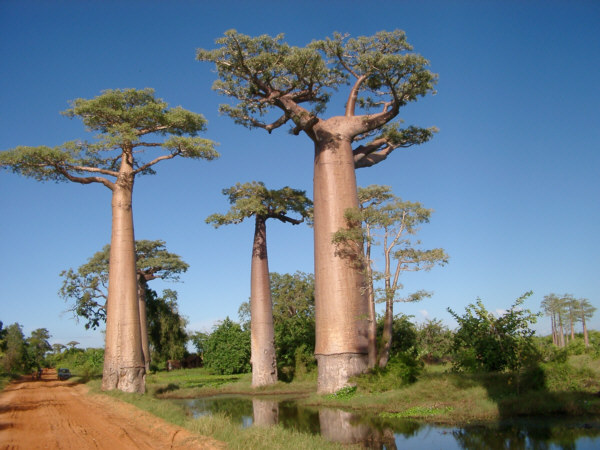
BAOBAB – MADAGASCAR
Baobabs, with their distinctive shape, are one of the most charismatic group of trees in the world. This particular specimen, located in Madagascar, is referred to as the ‘Teapot Baobab’. These trees remain leafless for most part of the year, and their thick, bloated, fire-resistant trunks store water during the dry months. One would be surprised to find that some baobab trunks are so large that people actually reside inside them!
GERMAN SHERMAN – (SEQUIA NATIONAL PARK)
General Sherman is about 2500years old tree with a height of 275 feet (83.8 metres), located in the Giant Forest of Sequoia National Park in the United States. In January 2006 the largest branch on the tree broke off. The breakage, however, could not change the General Sherman’s status as the largest tree! This stunning tree has the base of its trunk measuring about 102 feet in circumference. Witnesses to this spectacular creation of nature can only justify its stature!
SILK COTTON TREES OF TA PROHM,CAMBODIA
Ta Prohm Temple or the Jungle Temple which is located in the Angkor Thom complex has trees growing here in the most astounding way. Words cannot describe it until you set foot there and see it for yourself. Apparently, the place was left as is over the hundreds of years and the outcome is amazing from what you see now in the place which is also called Angkor Archaeological Park. On every side, in fantastic over-scale, the trunks of the silk-cotton trees soar skywards under a shadowy green canopy, their long spreading skirts trailing the ground and their endless roots coiling more like reptiles than plants.
TULE TREE OF OAXACA, MEXICO
Mexico’s most famous tree, the ginormous Tule Tree (Arbol del Tule) grows near Oaxaca City. It may not be the largest or the oldest tree in the world, but it has no contenders for widest girth award which is abround 164 feet in circumference.It’s best not to look atthe tree as a single icon. Indeed there is a family of ancient trees. Rooted in the town of Santa María del Tule, the Tule Tree and its environs comprise a unique natural monument.
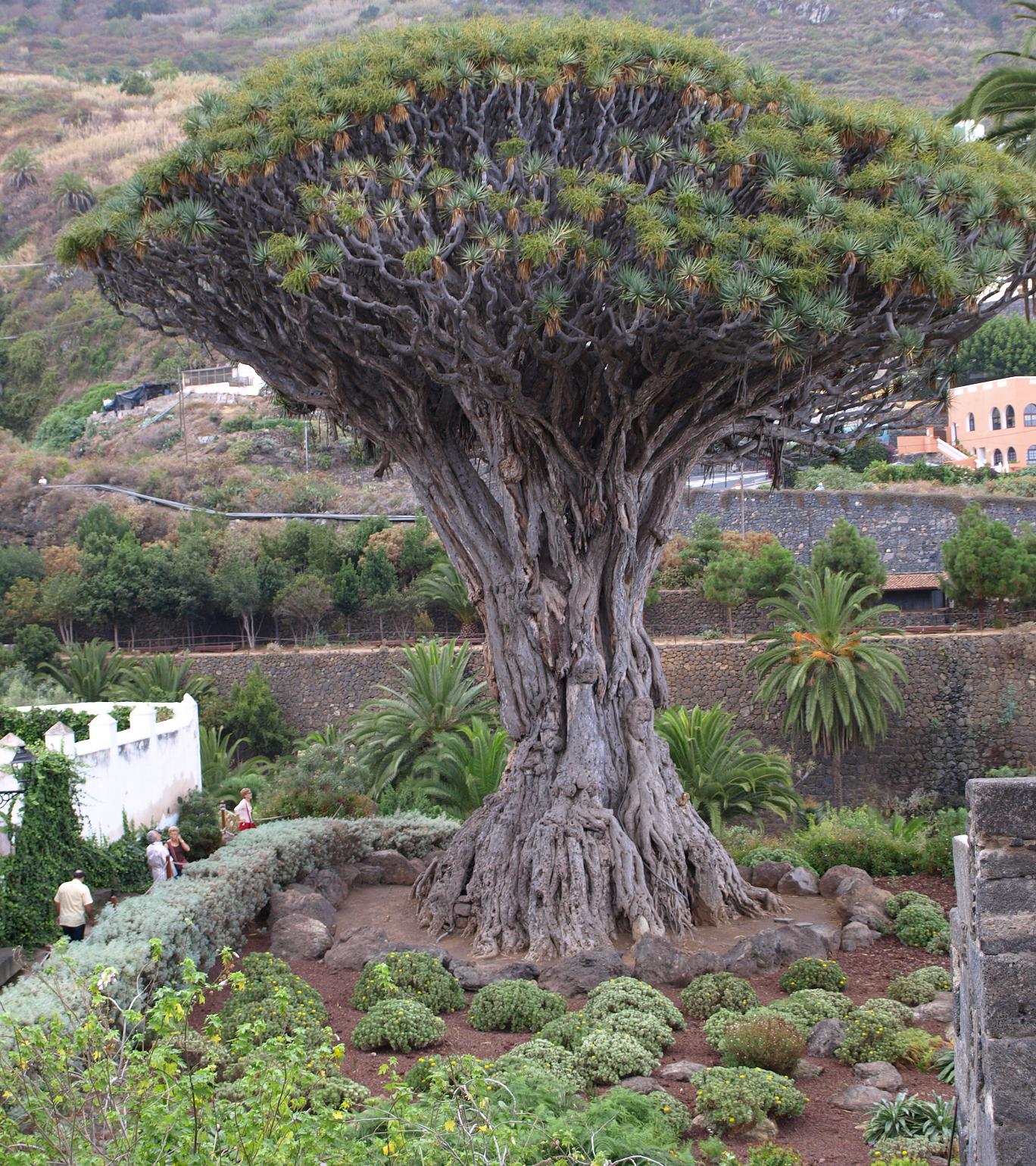
DRAGON TREE, CANARY ISLANDS
The Dragon Tree is found at de los Vinos in Tenerife, one of the Canary Islands, and is said to be between 650 and 1,500 years old. This specimen inherited this name from mythical origins: Hercules had to bring back three golden apples from the garden of the Hespérides, which is guarded by Landon, the hundred-headed dragon. Hercules killed Landon and his blood flowed out over the land, which began to sprout ‘dragon’ trees.The tree exudes ‘dragon’s blood’ – a red sap – when cut.
WOLLEMI PINE, AUSTRALIA
The unique qualities of the Wollemi Pine lie not in its looks but in its history. It is a “living dinosaur”, and was nearly extinct before it was discovered in Sydney, Australia in 1994. Now called “the crown jewels of the botanical world”, the Wollemi pine had previously been known only from a 120-million-year-old fossil. Very few exist in the wild, but conservation efforts have been made in the recent past.
These strange trees have been molded by Mother Nature into species of their own. Shocking, downright weird or seemingly beautiful, the trees amassed in this collection will leave you to ponder on wondrous creation the Almighty!
Labels:
NATURE,
PHOTOGRAPHY
7 Huge Holes in the Earth
These holes are not only amazing, but some of them are really terrifying! The sheer magnitude of these gaping holes reminds us of how men will scar the earth to pursue their quest for power and wealth.


This incredible geographical phenomenon known as a blue hole is situated 60 miles off the mainland of Belize. There are numerous blue holes around the world,
but none as stunning as this one


#1. Kimberley Big Hole – South Africa
Apparently the largest ever hand-dug excavation in the world, this 1097 meter deep mine yielded over 3 tons of diamonds before being closed in 1914
#2. Glory Hole – Monticello Dam, California
A glory hole is used when a dam is at full capacity and water needs to be drained from the reservoir. This is the ‘Glory Hole’ at Monticello dam, and it’s the largest in the world of this type of spillway, its size enabling it to consume 14,400 cubic feet of water every second
#3. Bingham Canyon Mine, Utah
This is supposedly the largest man-made excavation on earth. Extraction began in 1863 and still continues today, the pit increasing in size constantly. In its current state the hole is miles deep and 2.5 miles wide
#4. Great Blue Hole , Belize
but none as stunning as this one
#5. Mirny Diamond Mine , Siberia
- I’m pretty sure most people have seen this one. It’s an absolute beast and holds the title of largest open diamond mines in the world. At 525 meters deep, with a top diameter of 1200 meters, there’s even a no-fly zone above the hole due to a few helicopters having been sucked in
#6. Diavik Mine, Canada
The mine is so huge and the area so remote that it has its own airport with a runway large enough to accommodate a Boeing 737. It looks equally cool when the surrounding water is frozen
#7. Sinkhole in Guatemala
This photo is a sinkhole that occurred early this year in Guatemala . The hole swallowed a dozen homes and killed at least 3 people
Labels:
NATURE,
PHOTOGRAPHY
Subscribe to:
Posts (Atom)